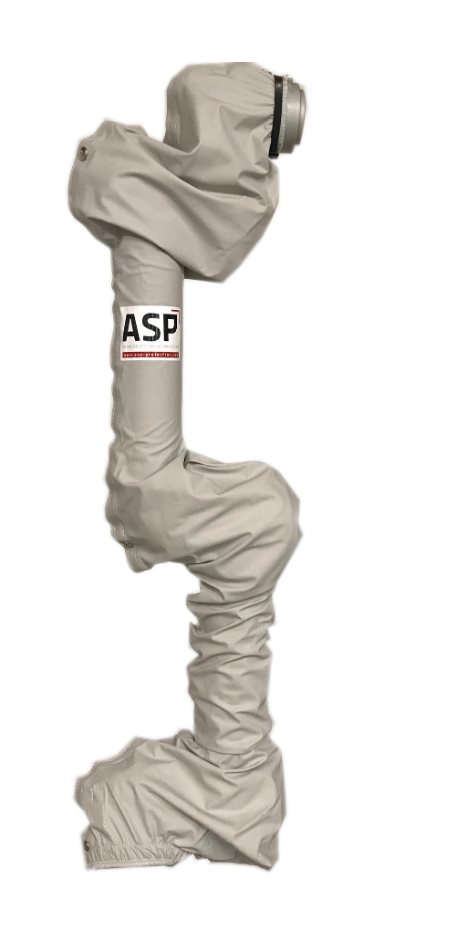
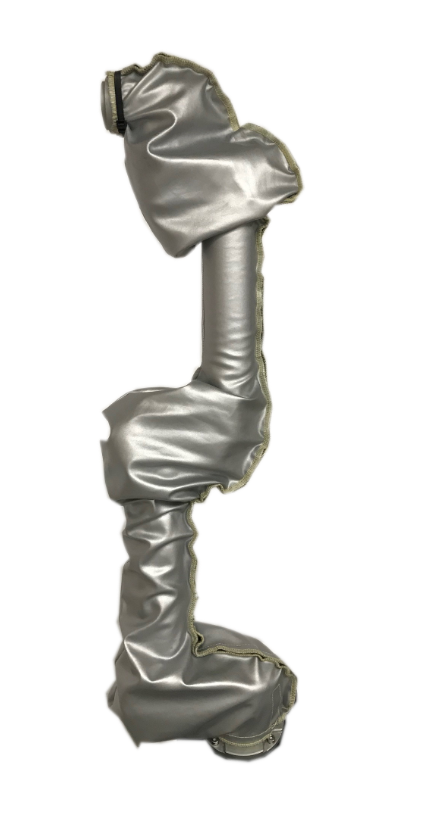
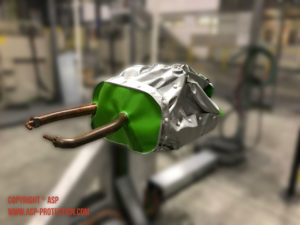
ASP is expanding its range with the arrival of BIFUSAL, a new fabric specially designed for the food industry.
Designed to meet strict hygiene and cleaning requirements, BIFUSAL combines technical performance and adaptability.
A technical textile adapted to agri-food requirements
BIFUSAL is a double-sided coated fabric certified for use in food environments:
excellent resistance to cleaning products used in the food industry
optimal protection for static equipment
high durability against washing and regular use
Its design also allows for:
the creation of watertight seams for enhanced protection
the integration of a transparent screen made of welded CRISTAL fabric, making it easier to read interfaces and screens
Protecting production line control equipment
BIFUSAL fabric is designed for the manufacture of custom-made protective covers for static equipment such as:
scales
screens
control panels
cabinets
and other sensitive equipment.
Each cover is tailored to the specific constraints and needs of the customer, ensuring optimal integration into the production environment.
BIFUSAL fabric for the food industry
A new-generation technical fabric designed to provide long-lasting protection for equipment in food environments, while meeting hygiene and industrial performance requirements.
After 22 years of success, TIFFON fabric, a historic benchmark at ASP, is evolving for the sixth time. We are pleased to announce the arrival of the new TIFFON-25, an improved version designed to meet current industrial requirements in forging and foundry workshops.
A more resistant fabric, designed to last
TIFFON-25 stands out thanks to its more resistant fabric weave, offering:
better durability over time
optimal stability when subjected to repeated stress
high tear resistance, for which TIFFON is renowned.
Visually, the fabric has also evolved: it has a smoother, more uniform appearance, with a more discreet weave. The difference is immediately noticeable.
The evolution of a technical fabric: quite a story!
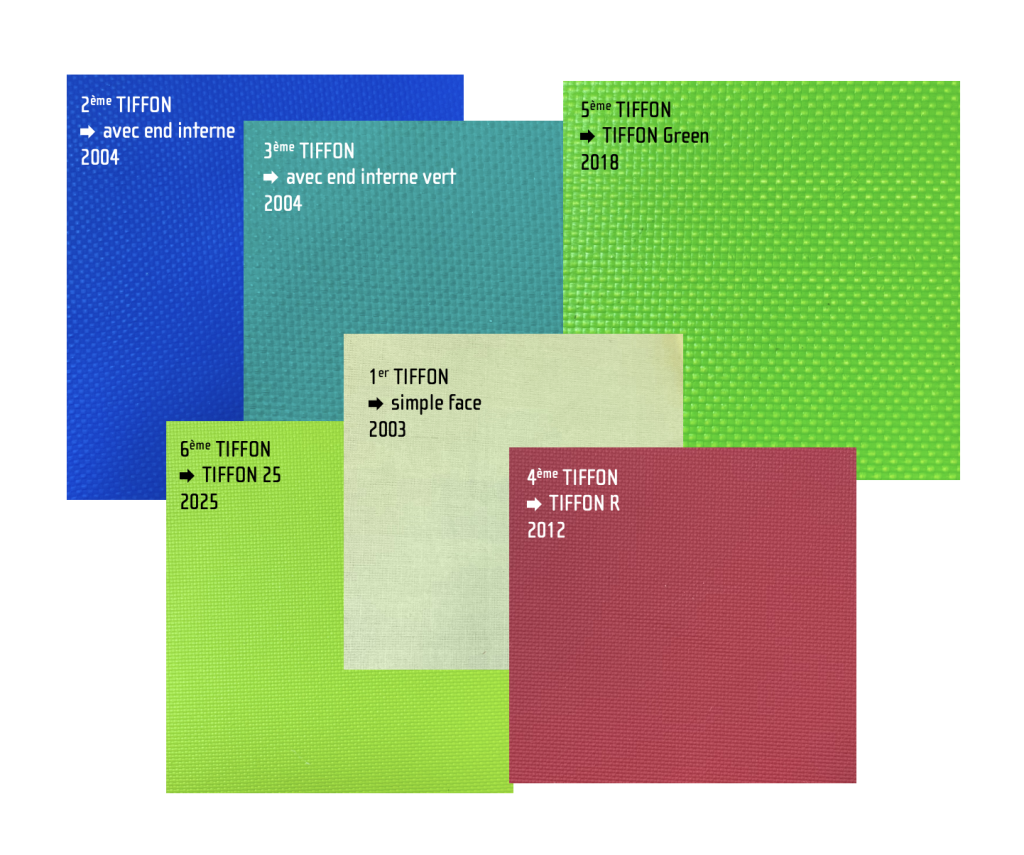
For over 20 years, TIFFON fabric has been evolving to meet the industrial needs and requirements of our customers. Each version marks a key milestone in improving its performance and uses.
TIFFON – single-sided (2003) First generation of TIFFON fabric, founding the range.
TIFFON with internal coating (2004) Introduction of internal coating to enhance functional performance.
TIFFON with green internal coating (2004)
TIFFON R (2012) A new step up the range, with performance adapted to more demanding environments.
TIFFON Green (2018) An iconic version, widely adopted and now a benchmark for many customers.
TIFFON-25 (2025) The latest evolution of TIFFON fabric, offering enhanced durability, improved stability, and an enhanced visual finish, while maintaining the performance that has made the range so successful.
An iconic fabric, always at the cutting edge of performance
TIFFON-25 is the latest iteration of an iconic ASP Protection fabric that has been used and proven in demanding environments for nearly 22 years. This new version, developed by our R&D department, confirms our commitment to advancing our solutions while maintaining the performance that has made them so successful.
ASP offers various forms of protection for robots, but it’s not always easy to choose the appropriate term. The commonly used term is “cover,” which refers to a type of fabric envelope that protects objects from dirt. Some of our clients have used other terms such as “safety suite,” “projective solution,” “jacket protection“, ” dresses for robots“, “clothes for industrials robots“, to describe our products. While these terms are not incorrect, we want to explain why at ASP, we emphasize the use of the term “cover.
What words can be used to describe an ASP cover?
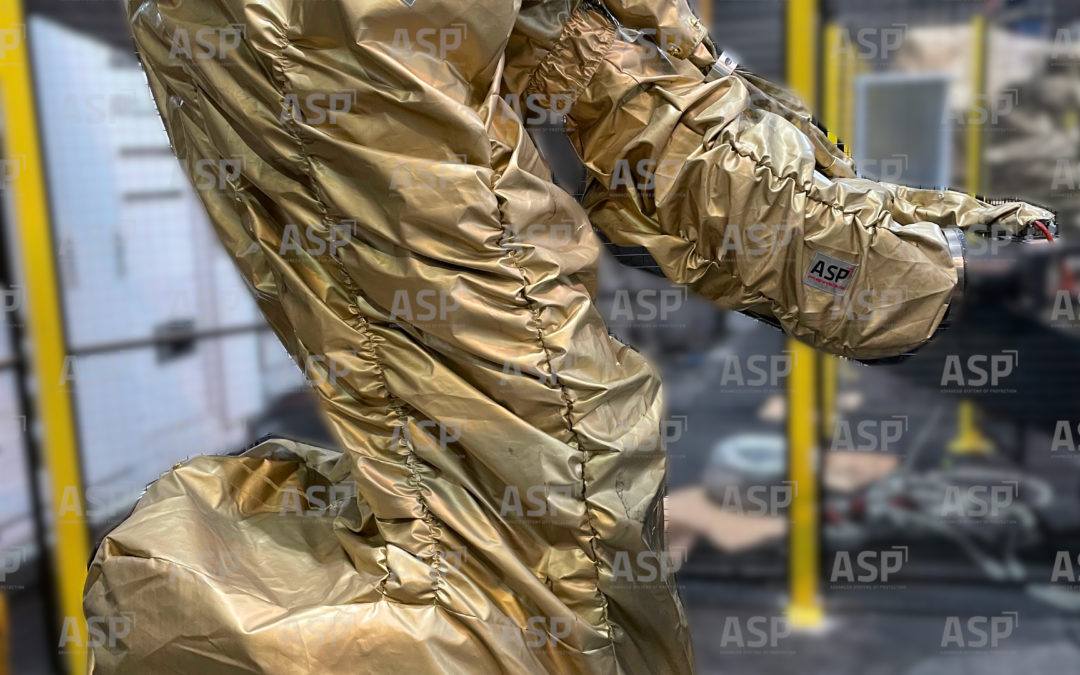
A cover is a word that describes a fabric covering for a rare and valuable object. In the industrial context, robots are often expensive and not easily replaceable. They allow companies to perform tasks in potentially hazardous environments for humans, such as navigating through flames in a foundry. By using the term “cover,” we aim to convey the image of an ASP protection acting as a shield against various processes, thereby maximizing the preservation of your robot from damage.
How do I find an ASP company on the Internet?
Words like “waterproof cover,” “robot sleeve,” or “heated cover system” do not reflect ASP’s commitment to protection. Indeed, these alternative terms can be confusing and do not highlight the actual performance of our products. This inconsistency can mislead our customers when searching on the internet. By choosing the right keyword, such as “cover,” our potential customers can find us more easily when looking for solutions for protecting industrial robots.
Attachment of robot protection covers: a new innovation from ASP Protection for the axis 1 hoop, the new easy ring.
ASP Protection’s R&D department is constantly seeking to improve robot covers and accessories, such as the axis 1 hoop, offered to customers.
Moreover, the steel axis 1 ring are used to attach the robot protection cover. Sturdy enough for a person to stand on without any issues, but they have the drawback of being heavy to handle. For the past 2 years, ASP Protection’s engineers and technicians have been working on a major evolution of this axis 1 ring. Now made of aluminum, the new Easy Ring, International patent application No. PCT/EP2023/077401, are just as strong and, more importantly, much lighter. They are therefore easier to handle and transport.
Indeed, the new Easy Ring is octagonal in shape, but no worries: existing covers fit perfectly. They easily attach to it. Designed for Easy range protection covers, the Easy Ring has many other advantages:
The octagon fits within the diameter of the steel ring and can easily substitute for a classic ring. Without hindering the process.
The diameter of this octagon adapts from 700 mm to 1300 mm. It is fitting robots from ABB, Fanuc, Kuka, Yaskawa, Comau, Kawasaki…
Grooves in the profile allow for the adaptation of various types of parts (air hoses, etc.).
Can be delivered with anti-tear or anti-pocket plates to prevent material accumulation in the folds of the protection cover.
Delivered pre-assembled on-site, the Easy Ring can be attached to your robot in less than 15 minutes.
For more information, contact your sales representative or call 03 83 22 88 55.
Some industrial robots evolve in extreme conditions, subjected to heat and / or hot or even incandescent projections. ASP has created specific covers for them, made of M1 classified fabric: they are non-flammable. Explanations…
French standard (NF) for reaction to fire
In fire safety, reaction to fire is characterised by the way a material will behave as combustible. It is defined by 2 criteria:
Combustibility: quantity of heat emitted by the complete combustion of the material
Flammability: amount of flammable gas emitted by the material
According to standard NF P. 92.507, these 2 criteria fall into 5 categories, from M0 (the most difficult to ignite) to M4 (the most easily inflammable). Materials classified M0 will hardly ignite while materials M4 will ignite very quickly.
Classification M1 and M0 of ASP fabrics
ASP has 10 different technical fabrics, respecting the classification M1 or M0. They are mainly used for the design of protective covers for robots in the automotive and aeronautic industries, in the forge and foundry.
Body assembly and welding
The shoeing activity in the automotive industry requires protective covers resistant to welding spatter. Based on aramid, the technical fabrics used provide excellent mechanical resistance for arc welding, spot or laser welding, and durably protect from splashes.
Wrist cover in Tiffon-R
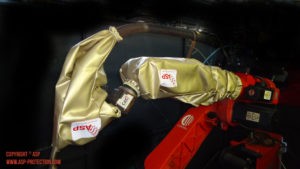
ASP has also developed a cover system for CMC (Clever Modular Concept – patented solution). The welding gun protection are protected by two technical fabrics classified M1:
Texalis, fabric coated on two sides, one of which in aluminized rubber, constitutes the body of the cover
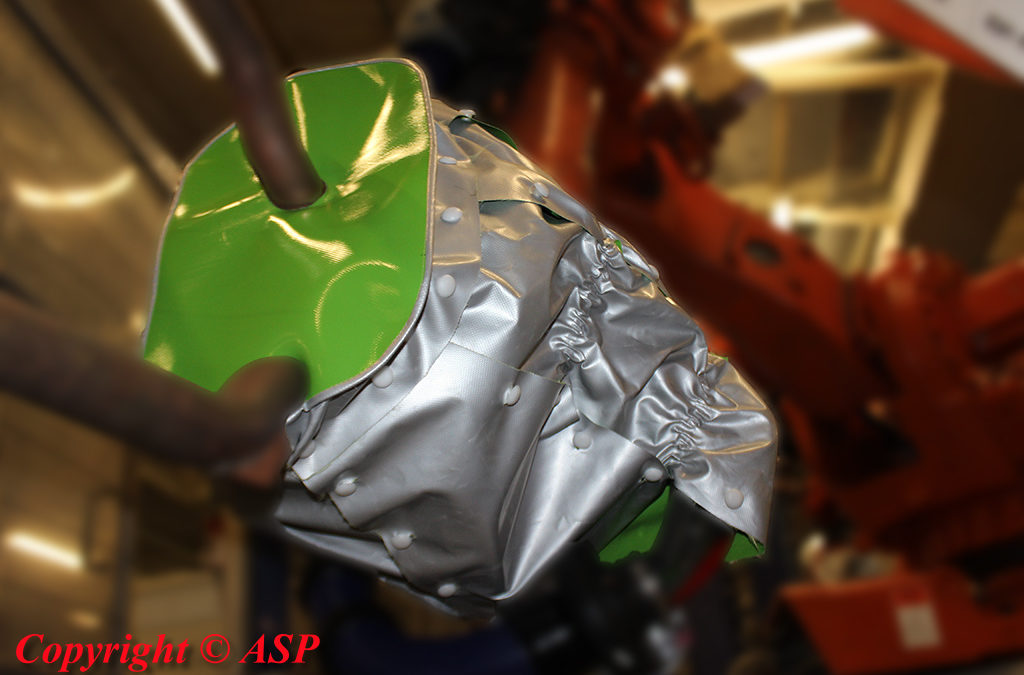
Cardel, which has a green elastomeric face, has a high resistance to sparks. It constitutes the plastron (thickness 2mm)
In addition, these 2 aramid-based fabrics are guaranteed to be silicone and halogen-free, and are tear-resistant.
Welding gun cover
Protections in the automotive industry
ASP propose également à ses clients de l’industrie automobile des housses de protection de véhicules fabriquées en Covel (un tissu technique orange classé M1 doublé d’un élastomère noir) ou en ELIT2. Sans silicone, il offre une très bonne protection contre les impacts, et bien sûr les projections chaudes accidentelles. La housse véhicule est fabriquée sur-mesure pour assurer une efficacité maximum aux opérateurs.
Pour offrir les meilleures expériences, nous utilisons des technologies telles que les cookies pour stocker et/ou accéder aux informations des appareils. Le fait de consentir à ces technologies nous permettra de traiter des données telles que le comportement de navigation ou les ID uniques sur ce site. Le fait de ne pas consentir ou de retirer son consentement peut avoir un effet négatif sur certaines caractéristiques et fonctions.
Fonctionnel
Always active
L’accès ou le stockage technique est strictement nécessaire dans la finalité d’intérêt légitime de permettre l’utilisation d’un service spécifique explicitement demandé par l’abonné ou l’utilisateur, ou dans le seul but d’effectuer la transmission d’une communication sur un réseau de communications électroniques.
Préférences
L’accès ou le stockage technique est nécessaire dans la finalité d’intérêt légitime de stocker des préférences qui ne sont pas demandées par l’abonné ou l’internaute.
Statistiques
Le stockage ou l’accès technique qui est utilisé exclusivement à des fins statistiques.Le stockage ou l’accès technique qui est utilisé exclusivement dans des finalités statistiques anonymes. En l’absence d’une assignation à comparaître, d’une conformité volontaire de la part de votre fournisseur d’accès à internet ou d’enregistrements supplémentaires provenant d’une tierce partie, les informations stockées ou extraites à cette seule fin ne peuvent généralement pas être utilisées pour vous identifier.
Marketing
L’accès ou le stockage technique est nécessaire pour créer des profils d’internautes afin d’envoyer des publicités, ou pour suivre l’utilisateur sur un site web ou sur plusieurs sites web ayant des finalités marketing similaires.